⚡ This product was generated with Kupkaike in under 4 minutes
Create Your Own Product →The definitive step-by-step relocation blueprint that takes remote workers from
International Relocation & Remote Work Lifestyle
Save 20+ hours per week. Replace $4,800/month in consulting fees.
The definitive step-by-step relocation blueprint that takes remote workers from is a 15k+-word digital International Relocation & Remote Work Lifestyle with 13 chapters, a cover image, sales copy, Pinterest pins, and a launch kit, all generated by Kupkaike's AI in under 10 minutes. Suggested retail price: $34.99.
From overwhelmed by contradictory Reddit threads, unsure about tax obligations, and afraid of making an expensive legal mistake → To having a complete, submitted visa application, a personalized tax optimization plan leveraging the Beckham Law, a city and neighborhood shortlisted to their budget, and a 90-day post-arrival action checklist that gets them legally registered, banked, and settled in Spain.
- ✓Eligibility Lock-In: Confirming You Qualify Before You Spend a Dime
- ✓The Document Arsenal: Building Your Bulletproof Application Package
- ✓Tax Architecture: The Beckham Law Strategy and Autónomo Optimization
- ✓City Selection Intelligence: Finding Your Ideal Spanish Base Beyond Barcelona
- ✓The Soft Landing Protocol: Your First 30 Days on the Ground
Everything Below Was AI-Generated
No editing, no design skills, no copywriting. Just a niche idea and Kupkaike did the rest.
What This Product Replaces
13 Chapters of Content
Generated by Claude Opus 4.6. Real content, unedited.
01The definitive step-by-step relocation blueprint that takes remote workers from
The definitive step-by-step relocation blueprint that takes remote workers from 'I want to move to Spain' to legally established, tax-optimized, and fully settled in under 90 days - covering the exact visa application process, Beckham Law tax strategy, padron registration, NIE/TIE timelines, and neighborhood-level city selection most relocation guides completely ignore.
Designed for: Remote workers and freelancers earning $50K, $150K/year (ages 28-45) currently based in the US, UK, or Canada who are seriously considering Spain's Digital Nomad Visa (Ley de Startups) but are paralyzed by conflicting information online about tax implications, application document requirements, healthcare enrollment, and whether they can actually afford Barcelona or Madrid on their income. They've spent 40+ hours on Reddit and Facebook groups and are more confused than when they started. They want a single, authoritative source that eliminates guesswork and prevents costly mistakes.
Transformation: From overwhelmed by contradictory Reddit threads, unsure about tax obligations, and afraid of making an expensive legal mistake → To having a complete, submitted visa application, a personalized tax optimization plan leveraging the Beckham Law, a city and neighborhood shortlisted to their budget, and a 90-day post-arrival action checklist that gets them legally registered, banked, and settled in Spain.
---
02Table of Contents
---
Like what you see?
03Chapter 1: Eligibility Lock-In: Confirming You Qualify Before You Spend a Dime
You've probably read seventeen contradictory Reddit threads about Spain's Digital Nomad Visa and still can't tell whether you actually qualify. This chapter ends that uncertainty - permanently.
Before you pay a gestor €1,500, book a consulate appointment, or start fantasizing about a Gràcia apartment, you need a definitive GO/NO-GO on your eligibility. The Spain Digital Nomad Visa (officially created under the Ley de Startups, Law 28/2022) is genuinely accessible to most location-independent earners - but it has specific disqualifiers that will sink your application if you walk in blind.
---
The Qualification Triage System
This framework has four sequential gates. You must pass all four before spending money on document preparation. Work through them in order - if you fail Gate 1, Gates 2-4 are irrelevant.
Gate 1: Residency History (The 5-Year Clean Slate)
You cannot have been a legal resident of Spain within the five years immediately preceding your application. This sounds simple. It isn't.
What counts as residency: A prior TIE (Tarjeta de Identidad de Extranjero), a long-stay visa (student, work, family reunification), or any visa category that established legal residency. A prior NIE number alone does not disqualify you - the NIE is just an identification number. Plenty of people have NIE numbers from buying property or opening accounts as non-residents. That's fine.
What does NOT count: Tourist stays under 90 days, even repeated ones. If you spent three months in Spain on a tourist visa in 2021, that is not residency. However, if you overstayed a tourist visa and were formally documented doing so, you have a different problem (see Gate 4).
Edge case - prior student visas: If you did a semester abroad or a language course in Spain on a student visa, check the dates. If that visa expired more than five years before your application date, you're clear. If it was within five years, you are disqualified from the Digital Nomad Visa until the five-year window passes. There is no workaround.
Gate 2: Income Verification (The 200% IPREM Threshold)
The minimum income requirement is 200% of Spain's IPREM (Indicador Público de Renta de Efectos Múltiples). As of 2024, IPREM is €600/month, making the threshold €1,200/month - but that's the Spanish figure. For US/UK/Canadian applicants, consulates typically apply a purchasing-power-adjusted equivalent, and in practice most consulates want to see the equivalent of approximately $2,500-$2,800 USD per month in consistent, documented income.
Additional family members increase this: each additional adult adds 75% of IPREM; each child adds 25%. A family of four needs roughly €2,700/month minimum - plan for $3,500+ to be safe.
How you prove it depends on your track:
Gate 3: Employer Jurisdiction Check (Remote Employee Track Only)
If you're applying as a remote employee, your employer must be incorporated outside Spain. A US company, a UK Ltd, a Canadian corporation - all fine. A Spanish S.L. or S.A. - disqualifying. Additionally, at least 80% of your income must come from non-Spanish sources. If you have Spanish freelance clients making up more than 20% of your revenue, you need to restructure before applying.
Gate 4: Criminal Background and Tax Clean Slate
You need criminal background certificates from every country where you've lived for more than six months in the past five years. For most US applicants, this means an FBI federal background check (not a state-level check - federal). UK applicants need an ACRO certificate. Canadian applicants need an RCMP certificate. These take time: FBI checks run 12-16 weeks via mail, or 8-10 weeks through a channeler service.
Any prior Spanish tax debt - even a small underpayment from a previous stay - will flag in the Agencia Tributaria system and can pause or kill your application. If you've ever filed Spanish taxes, get a certificado de estar al corriente (certificate of being current on tax obligations) before you apply.
---
Real-World Example
Scenario: Maya, 34, UX Designer, Austin, TX
Maya earns $96,000/year as a full-time remote employee of a Boston-based SaaS company. She did a language immersion program in Seville in 2018 on a student visa that expired in August 2019. She's applying in November 2024 - that's five years and three months since her student visa expired. She clears Gate 1.
Her salary is $8,000/month, well above the income threshold. Her employer is US-incorporated with zero Spanish operations. She clears Gates 2 and 3.
She's never had a criminal conviction and has never filed Spanish taxes. She orders her FBI background check through an FBI-approved channeler (Accurate Biometrics, $18 service fee on top of the FBI's $18 fee) and gets results in nine days. She clears Gate 4.
Maya's status: GO. She proceeds to document collection.
Now consider a variation: if Maya's student visa had expired in March 2020, she'd be applying inside the five-year window and would be disqualified until March 2025. The fix isn't complicated - she'd simply wait - but discovering this after paying a gestor and booking flights would be an expensive mistake.
---
Worksheet: The 28-Point Eligibility Verification Checklist
Instructions: Work through each item. In the "Status" column, mark: ✅ Have it | 🔄 Need to obtain | ❌ Disqualifier. At the end, tally your results to determine your overall status.
---
SECTION A: Residency History (Gate 1)
| # | Criterion | Status | Document Proof You Have/Need |
|---|-----------|--------|------------------------------|
| 1 | I have NOT held a Spanish residency visa in the past 5 years | | |
| 2 | I have NOT held a TIE card in the past 5 years | | |
| 3 | Any prior Spanish student visa expired more than 5 years ago | | |
| 4 | I have NOT overstayed a Spanish tourist visa and been formally documented | | |
| 5 | I confirm: a prior NIE number (without residency) does NOT disqualify me | | |
SECTION B: Income Verification (Gate 2)
| # | Criterion | Status | Document Proof You Have/Need |
|---|-----------|--------|------------------------------|
| 6 | My gross monthly income meets or exceeds $2,520 USD (solo applicant) | | |
| 7 | If bringing a partner: income meets $2,520 + 75% IPREM additional | | |
| 8 | If bringing children: income accounts for 25% IPREM per child | | |
| 9 | I have 3-6 months of payslips OR 6-12 months of invoicing history | | |
| 10 | My bank statements show consistent deposits matching claimed income | | |
| 11 | I have a signed employment contract OR active client contracts | | |
| 12 | My income is stable (not a single large payment in the last 3 months) | | |
SECTION C: Employer/Client Jurisdiction (Gate 3 - Remote Employees)
| # | Criterion | Status | Document Proof You Have/Need |
|---|-----------|--------|------------------------------|
| 13 | My employer is incorporated OUTSIDE Spain | | |
| 14 | At least 80% of my income comes from non-Spanish sources | | |
| 15 | I can obtain a letter from my employer confirming remote work authorization | | |
| 16 | The employer letter will confirm I am authorized to work from Spain specifically | | |
| 17 | My employer has been operating for at least 1 year (some consulates require this) | | |
SECTION C (alt): Freelancer/Founder Track
| # | Criterion | Status | Document Proof You Have/Need |
|---|-----------|--------|------------------------------|
| 13F | I have at least 2 distinct clients (reduces disguised employment risk) | | |
| 14F | I have 6-12 months of invoices and corresponding bank deposits | | |
| 15F | My business activity qualifies as "digital/remote" in nature | | |
| 16F | (Founders only) My company is in an innovation sector per Ley de Startups | | |
| 17F | (Founders only) I have company incorporation documents and cap table | | |
SECTION D: Criminal Background and Tax Status (Gate 4)
| # | Criterion | Status | Document Proof You Have/Need |
|---|-----------|--------|------------------------------|
| 18 | I have NO criminal convictions in any country | | |
| 19 | I have identified every country I've lived in for 6+ months in the past 5 years | | |
| 20 | I have ordered/received FBI federal background check (US applicants) | | |
| 21 | I have ordered/received ACRO certificate (UK applicants) | | |
| 22 | I have ordered/received RCMP certificate (Canadian applicants) | | |
| 23 | I have NO outstanding Spanish tax debt | | |
| 24 | If I've previously filed Spanish taxes, I have a certificado de estar al corriente | | |
SECTION E: Timeline and Logistics
| # | Criterion |
04Chapter 2: The Document Arsenal: Building Your Bulletproof Application Package
You've confirmed your eligibility using the Qualification Triage System. Now comes the part that actually kills most applications - not missing a document, but showing up with the wrong version of the right document. Spanish consulates reject incomplete packages at a rate that would shock you, and "incomplete" often means a document that's present but improperly apostilled, expired by two weeks, or translated by someone who isn't a traductor jurado.
---
The Document Stack Method
The Document Stack Method treats your application package as a layered system where every document has a defined state it must reach before submission. There are four states: Sourced → Apostilled → Translated → Verified. Not every document passes through all four states, but every document must be tracked against all four to confirm it either completed the step or was correctly exempted from it.
Here's the complete five-step process:
Step 1: Build Your Master Inventory by Track
Your document requirements differ depending on whether you're applying as an employee, a freelancer (autónomo), or a company director. Based on the track you identified in Chapter 1, pull from the relevant column below:
Step 2: Determine Apostille vs. Legalization Requirements
Spain is a signatory to the Hague Convention, which means documents issued in the US, UK, and Canada can be authenticated via Apostille rather than full diplomatic legalization - a faster and cheaper process. The rule is simple: any public document requires an Apostille. Private documents do not.
Public documents requiring Apostille: FBI background check, birth certificate (if requested), marriage certificate (if applicable), university degree (if used as professional credential proof), and any notarized documents.
FBI background checks are the most time-sensitive piece of this stack. Order through the FBI's Identity History Summary program at fbi.gov/how-we-can-help-you/more-fbi-services-and-information/identity-history-summary-checks. Standard processing is 12-14 weeks. Channeler services (listed on the FBI site) can reduce this to 5-7 business days for roughly $75-$125 extra. Once received, take it to your state's Secretary of State office for Apostille - not the federal government. This is a common error. The FBI check itself is a federal document, but the Apostille is applied at the state level where you reside.
Step 3: Identify What Requires Sworn Translation
Spain requires that any document not in Spanish be translated by a traductor jurado - a sworn translator officially accredited by Spain's Ministry of Foreign Affairs. This is not optional and cannot be substituted with a certified translation from a US-based service, regardless of their credentials.
Documents requiring sworn translation: criminal background check, employment contract or client contracts, payslips, bank statements, company registration documents, and any supporting letters.
To find an accredited traductor jurado, use the official directory at maec.es (Spain's Ministry of Foreign Affairs website) and search under "Traductores e Intérpretes Jurados." Budget €30-€80 per page depending on language complexity and turnaround time. A typical application package runs 25-40 pages of translatable content, so budget €1,000-€2,500 for this line item. Turnaround is typically 5-10 business days per document set.
Step 4: Draft Your Employer Authorization Letter (Employee Track)
This document is underestimated and frequently the reason employee-track applications stall. The consulate needs to see explicit confirmation that your employer authorizes remote work from Spain and that your client base does not primarily serve Spanish entities.
The letter must include on company letterhead: your full name, job title, start date, annual salary, confirmation that your role is 100% remote, a statement that the company has no physical presence in Spain, and - critically - the following clause or equivalent language:
"[Employee name]'s work does not involve providing services to clients based in Spain, and clients or customers located in Spain do not represent more than 20% of [Employee name]'s total client portfolio or revenue."
Without this clause, consular officers will flag the application for potential labor law conflicts. Have your HR department or direct manager sign it, and have it notarized - then Apostilled.
Step 5: Secure Compliant Health Insurance
This is where more applications fail than anywhere else. Travel insurance, international health plans marketed to expats, and policies with "Spain coverage" clauses are routinely rejected. The consulate requires a policy from a provider authorized to operate in Spain, with no co-pays, no deductibles, and no coverage gaps.
The three providers with policy types that consistently satisfy consular requirements are:
Expect to pay €80-€180/month depending on age and coverage tier. Purchase the policy before you submit your application, and request a certificate of coverage in Spanish explicitly stating there are no territorial exclusions within Spain and no deductible requirements. Some providers issue this automatically; others require you to request it specifically.
---
Real-World Example
Scenario: Marcus, 34, works remotely as a senior UX designer for a Toronto-based SaaS company earning CAD $95,000/year. He qualified under the employee track in Chapter 1. He starts his Document Stack in January with a target submission date of April 15.
His first move is ordering his RCMP criminal record check (Canada's equivalent of the FBI check) through an accredited fingerprinting service - 8-week turnaround. Simultaneously, he emails HR for the employer authorization letter, specifying the exact language required for the 20% Spanish client clause. HR initially sends a generic remote work confirmation; Marcus sends them the required language and gets the corrected version within a week.
He locates a traductor jurada through the maec.es directory who specializes in English-Canadian documents and quotes him €1,400 for the full package. He staggers document delivery to the translator as each arrives rather than waiting for everything - this saves him three weeks.
His Apostille for the RCMP check goes through Global Affairs Canada (Canada's equivalent process), which takes 4 weeks. He builds a 3-week buffer before his April 15 submission date and hits it with 18 days to spare. His application is accepted without a request for additional documentation.
The difference between Marcus and the applicant who gets rejected? He treated the Document Stack as a project with dependencies, not a checklist to complete in one sitting.
---
Worksheet: The Document Stack Tracker
Copy this template into a spreadsheet. Add one row per document. Update the Status column weekly.
| Document Name | Track (E/F/D) | Status | Source / URL | Cost | Date Ordered | Est. Arrival | Apostille Needed? | Apostille Status | Translation Needed? | Translation Status | Expiry Date | Notes |
|---|---|---|---|---|---|---|---|---|---|---|---|---|
| Passport (valid 12+ mo.) | All | | - | - | - | - | No | - | No | - | Check expiry | |
| FBI / RCMP Background Check | All | | fbi.gov / RCMP portal | $18 + channeler | | | Yes | | Yes | | 3-6 mo. from issue | Order first |
| Employment Contract | E | | HR dept. | $0 | | | Yes (notarized) | | Yes | | N/A | Include 20% clause |
| Employer Authorization Letter | E | | HR dept. | $0 | | | Yes (notarized) | | Yes | | N/A | Use exact language |
| Last 3 Payslips | E | | Payroll portal | $0 | | | No | - | Yes | | N/A | |
| Bank Statements (3 mo.) | All | | Online banking | $0 | | | No | - | Yes | | N/A | Show €2,646+/mo. |
| Client Contracts | F | | Client files | $0 | | | No | - | Yes | | Check end dates | |
| Invoices (12 mo.) | F | | Accounting software | $0 | | | No | - | Yes | | N/A | |
| Health Insurance Certificate | All | | Sanitas/Adeslas/Asisa | €80-180/mo | | | No | - | Request in Spanish | - | Annual renewal | Specify no deductible |
| Proof of Accommodation | All | | Rental agreement | $0 | | | No | - | Yes | | Match lease dates | |
| Company Incorporation Docs | D | | Company registry | Varies | | | Yes | | Yes | | N/A | |
Status options: Not Started / Ordered / Received / Apostilled / Translated / Complete
---
Quick Checklist
The single most expensive mistake applicants make at this stage is treating the document phase as a waiting game. You gather, you sit, you wait for the appointment, and somewhere in that gap a bank statement ages out or a criminal background check crosses its ninety-day validity window and you are back at the beginning for that one document, which then delays everything else because the package cannot be submitted incomplete. The fix is to build your timeline backwards from your target submission date, assign a hard deadline to every single item, and treat those deadlines with the same seriousness you would give a closing date on a property purchase. Nothing in this process is self-managing.
One final note on the human element: consulate staff are not your adversaries, but they are not your advisors either. They will tell you whether your package is complete or incomplete on the day you submit it. They will not tell you in advance what they prefer, they will not review a draft, and they will not make exceptions for documents that are close enough. Your job is to arrive with a package so clean and so clearly organized that the reviewing officer can move through it in minutes without having to search for anything or make a judgment call in your favor. Tabs, labels, logical sequencing, and a cover sheet that maps every item to the corresponding checklist requirement are not bureaucratic theater. They are the difference between an approval that moves forward and a request for further documentation that costs you weeks.
When the package leaves your hands, the active work of this phase is done. What comes next is the waiting period, the approval pathway, and the decisions you will need to make on the ground once you arrive.
Like what you see?
05Chapter 3: Tax Architecture - The Beckham Law Strategy and Autónomo Optimization
You've confirmed you qualify for the Digital Nomad Visa. Now comes the question that will determine whether your Spain move is a financial upgrade or an expensive mistake: exactly how much of your income will Spain take, and how do you legally minimize that number before you land?
---
The Dual-Regime Tax Blueprint
Spain offers two fundamentally different tax tracks for incoming remote workers, and the one you land on isn't just a preference - it's determined by your employment structure, income sources, and how quickly you apply after arriving. Getting this wrong costs real money: the difference between the Beckham Law and standard progressive rates on a $100K income can exceed €15,000 annually.
Here's the framework, broken into five decision points:
Step 1: Determine Your Residency Tax Status
Spain's tax authority (Agencia Tributaria) considers you a tax resident if you spend more than 183 days per calendar year in Spain, or if your primary economic interests are based there. Once you cross that threshold, you file under IRPF (Impuesto sobre la Renta de las Personas Físicas) - Spain's resident income tax - and your worldwide income becomes taxable in Spain. Before that threshold, you're technically an IRNR (Impuesto sobre la Renta de No Residentes) filer, taxed only on Spanish-sourced income at a flat 24%.
The critical trap: many digital nomads assume they can stay in Spain for 8-9 months and still claim non-residency. They can't. The 183-day count is cumulative within a calendar year, and Spain can use "center of vital interests" as a secondary test even if you're under 183 days. If your partner lives in Madrid and your clients are in Austin, Spain will argue you're resident regardless of your passport stamps.
Step 2: Apply for Beckham Law Status (RETD)
The Régimen Especial de Trabajadores Desplazados - colloquially called the Beckham Law after the footballer who famously used it - allows qualifying new residents to pay a flat 24% on Spanish-sourced income up to €600,000, rather than Spain's progressive IRPF rates of 19% to 47%. Above €600K, the rate jumps to 47%, but that ceiling affects very few remote workers in this income bracket.
The eligibility requirements are specific:
Step 3: Understand What "Spanish-Sourced Income" Actually Means for Remote Workers
This is where most online advice falls apart. If you're a US-based employee working remotely for your US employer while living in Spain, your income is technically sourced where the work is performed - Spain. Under the Beckham Law, that income is taxed at 24% flat. Without Beckham Law, it enters the progressive IRPF bracket system starting at 19% and climbing to 47% above €60,000.
Foreign investment income (dividends, capital gains, rental income from property outside Spain) is treated differently under Beckham Law - it's generally exempt from Spanish taxation, which is a significant advantage for anyone with a US brokerage account generating passive income.
Step 4: Register as Autónomo (If You're Freelancing)
If you're not a salaried employee but a freelancer or independent contractor - common for UK and Canadian remote workers - you must register as autónomo with the Agencia Tributaria and Social Security. The current reduced rate (tarifa plana) is €80/month for the first 12 months, stepping up incrementally based on your net income in subsequent years under the cuota system introduced in 2023.
As an autónomo, your quarterly obligations are:
Beckham Law and autónomo status can coexist - you can be registered as autónomo and still elect RETD treatment, filing under Modelo 151 instead of the standard Modelo 100.
Step 5: Apply Your Home-Country Treaty
Spain has double taxation treaties with the US, UK, and Canada. The operative articles for remote workers are typically Article 15 (Employment Income) and Article 7 (Business Profits for freelancers). Under these treaties, you generally receive a foreign tax credit in your home country for taxes paid in Spain - meaning you don't pay twice, you pay the higher of the two rates.
US citizens: You still file a US return annually (FBAR if foreign accounts exceed $10K, FATCA Form 8938 if foreign assets exceed $50K). The Foreign Earned Income Exclusion (FEIE) and Foreign Tax Credit (FTC) are your two tools - they cannot both apply to the same income, and the FTC is generally more advantageous under Beckham Law because the 24% Spanish rate often exceeds the FEIE benefit.
UK citizens: The UK-Spain treaty is straightforward for employment income. If you've properly notified HMRC of your departure and established Spanish residency, UK PAYE stops and Spain becomes your primary taxing jurisdiction.
Canadian citizens: Canada taxes on residency, not citizenship. Formally severing Canadian residency (Form NR73 determination) before establishing Spanish residency is essential - otherwise CRA will continue treating your worldwide income as Canadian-sourced.
Modelo 720 - The Asset Declaration You Cannot Ignore
If you hold foreign bank accounts, investment accounts, or real estate with a combined value exceeding €50,000, you must file Modelo 720 annually. The penalties for non-compliance historically reached 150% of the undeclared asset value (the EU partially struck down these penalties in 2022, but Spain still enforces significant fines). File it. Every year. By March 31.
---
Real-World Example
Scenario: Sarah, 34, Product Manager, Toronto → Barcelona
Sarah earns CAD $110,000 (~€75,000) annually as a remote employee of a Canadian tech company. She has a TFSA worth €60,000 in Canadian equities generating €3,000/year in dividends, and no Spanish income sources.
Without Beckham Law (standard IRPF):
With Beckham Law (RETD election via Modelo 149):
Sarah also registers as autónomo for a small consulting side project (€8,000/year). Under Beckham Law, this additional income is taxed at 24% flat - €1,920 - rather than the 45%+ marginal rate it would hit under standard IRPF.
Over six years of Beckham Law eligibility, Sarah's tax optimization generates approximately €85,000 in cumulative savings compared to standard Spanish progressive rates.
---
Worksheet: Tax Regime Comparison Calculator
Use this worksheet to calculate your estimated annual tax burden under each scenario. Work through all three columns before making any decisions.
---
SECTION A: YOUR INCOME PROFILE
| Input | Your Number |
|---|---|
| Annual employment/freelance income (€) | €____________ |
| Annual investment income - dividends, capital gains (€) | €____________ |
| Annual rental income from foreign property (€) | €____________ |
| Total gross annual income (€) | €____________ |
| Country of current tax residency | ____________ |
| Employment structure (employee / freelancer / mixed) | ____________ |
| Years since last Spanish tax residency | ____________ |
---
SECTION B: BECKHAM LAW ESTIMATE
| Calculation | Your Number |
|---|---|
| Employment/freelance income × 24% | €____________ |
| Investment income (foreign-sourced) × 0% (exempt) | €0 |
| Investment income (Spanish-sourced, if any) × 19% | €____________ |
| Estimated Spanish tax under Beckham Law | €____________ |
| Do you qualify? (No Spanish residency in prior 5 years: Y/N) | ____________ |
| Modelo 149 deadline (6 months from Social Security registration) | ____________ |
---
SECTION C: STANDARD AUTÓNOMO / IRPF ESTIMATE
Use Spain's 2024 progressive brackets: 19% (€0-€12,450), 24% (€12,450-€20,200), 30% (€20,200-€35,200), 37% (€35,200-€60,000), 45% (€60,000-€300,000), 47% (above €300,000).
| Calculation | Your Number |
|---|---|
| Tax on first €12,450 (×19%) | €2,365 |
| Tax on €12,450-€20,200 (×24%) | €1,860 |
| Tax on €20,200-€35,200 (×30%) | €4,500 |
| Tax on €35,
06Chapter 4: City Selection Intelligence: Finding Your Ideal Spanish Base Beyond Barcelona
You've already confirmed your eligibility. Now comes the decision that will define your daily quality of life for the next one to three years - and most people get it catastrophically wrong by defaulting to the two cities they've heard of.
The City-Fit Matrix
The City-Fit Matrix is a weighted scoring system that eliminates the emotional noise from city selection and replaces it with a structured comparison across eight factors that actually matter to Digital Nomad Visa holders. The key word is weighted - a freelance developer who needs fiber internet and quiet focus time should not be running the same analysis as a social media consultant who needs a buzzing expat network and rooftop bars.
The Eight Scoring Factors:
Each city receives a score from 1-10 on each factor. You assign a personal priority weight (1-10) to each factor. Multiply score × weight, sum the totals, and your top cities surface mathematically rather than emotionally.
The 12-City Snapshot (Pre-Populated Scores):
| City | Cost | Digital Infra | Nomad Community | Climate | English | Airport | Nature | Local Immersion |
|---|---|---|---|---|---|---|---|---|
| Madrid | 5 | 9 | 9 | 7 | 7 | 10 | 5 | 6 |
| Barcelona | 3 | 9 | 10 | 8 | 8 | 9 | 7 | 4 |
| Valencia | 7 | 8 | 7 | 9 | 6 | 7 | 8 | 7 |
| Málaga | 7 | 7 | 8 | 9 | 8 | 8 | 8 | 6 |
| Seville | 8 | 7 | 5 | 6 | 5 | 7 | 5 | 9 |
| Alicante | 8 | 6 | 4 | 9 | 7 | 7 | 8 | 7 |
| Bilbao | 6 | 8 | 4 | 5 | 4 | 6 | 9 | 9 |
| Las Palmas | 9 | 7 | 8 | 10 | 6 | 6 | 9 | 7 |
| Tenerife | 8 | 6 | 6 | 10 | 7 | 6 | 10 | 7 |
| Granada | 9 | 5 | 3 | 7 | 4 | 4 | 9 | 10 |
| San Sebastián | 4 | 7 | 2 | 5 | 4 | 5 | 10 | 9 |
| Palma de Mallorca | 5 | 7 | 5 | 9 | 7 | 7 | 9 | 5 |
The Hidden Cost Trap - Tourist Tax Zones
Before you fall in love with a neighborhood from Instagram, understand this: Spain's short-term rental explosion has created micro-zones within cities where rents are 40-60% inflated relative to adjacent barrios with identical quality of life. In Barcelona, El Born and Barceloneta command €1,400-1,800/month for a one-bed. Cross into Poblenou or Sant Andreu - 12 minutes by metro - and the same apartment runs €950-1,150. In Málaga, the Soho district has become a tourist-tax trap; Huelin or Pedregalejo offer the same Mediterranean lifestyle at €700-900/month. In Valencia, Ruzafa is the darling of every nomad blog and now prices reflect it at €950-1,200/month; meanwhile, Benimaclet and Patraix offer comparable walkability and café culture at €650-850/month.
Neighborhood-Level Cost Benchmarks (1-Bed Apartment + Monthly Costs):
| Location | Rent | Coworking Pass | Grocery Basket | Avg. Dinner Out |
|---|---|---|---|---|
| Ruzafa, Valencia | €1,050 | €180 | €280 | €18 |
| Benimaclet, Valencia | €750 | €160 | €260 | €14 |
| El Born, Barcelona | €1,600 | €220 | €320 | €25 |
| Poblenou, Barcelona | €1,100 | €200 | €300 | €20 |
| Soho, Málaga | €1,000 | €150 | €270 | €16 |
| Huelin, Málaga | €750 | €130 | €250 | €13 |
| Lavapiés, Madrid | €1,100 | €190 | €290 | €17 |
| Vallecas, Madrid | €850 | €170 | €270 | €14 |
| Triana, Seville | €850 | €140 | €250 | €14 |
| Las Palmas Centro | €800 | €150 | €260 | €14 |
Grocery basket = weekly shop for one person at Mercadona. Coworking = standard hot desk monthly pass.
---
Real-World Example
Scenario: Jamie, 34, UX Designer, Toronto - Budget €2,200/month all-in
Jamie earns CAD $95,000/year as a freelance UX designer with two anchor clients in North America. She completed the Qualification Triage System from Chapter 1 and confirmed she qualifies for the Digital Nomad Visa. Her priorities: reliable fiber internet for video calls, a social nomad community (she's moving solo), warm weather, and keeping total monthly spend under €2,200.
She runs the City-Fit Matrix with her personal weights:
Her top three results: Málaga (Huelin barrio), Valencia (Benimaclet), and Las Palmas de Gran Canaria (Guanarteme neighborhood).
Barcelona scored well on nomad community but her cost weight of 10 buried it - she'd be over budget in any livable neighborhood. Madrid scored similarly. Málaga's Huelin gives her a €750 one-bed, a €130 coworking pass at spaces like La Mina Coworking (500Mbps fiber), and a nomad Meetup scene that runs weekly events through the Málaga Digital Nomads group (1,200+ members). Total monthly burn: €1,950. She has €250 buffer.
She books a 30-day trial stay in Huelin before signing a 6-month lease. This is the move.
---
Worksheet: The City-Fit Scoring Matrix
Step 1: Assign Your Personal Priority Weights (1 = doesn't matter, 10 = dealbreaker)
| Factor | My Weight (1-10) |
|---|---|
| Cost of Living | _______ |
| Digital Infrastructure | _______ |
| Nomad Community Density | _______ |
| Climate Profile | _______ |
| English-Friendliness | _______ |
| Airport Connectivity | _______ |
| Nature & Lifestyle Access | _______ |
| Local Immersion Preference | _______ |
Step 2: Multiply Your Weight × City Score for Your Top 6 Candidate Cities
(Use the pre-populated city scores from the table above)
| City | Cost ×W | Digital ×W | Community ×W | Climate ×W | English ×W | Airport ×W | Nature ×W | Immersion ×W | TOTAL |
|---|---|---|---|---|---|---|---|---|---|
| _____________ | | | | | | | | | |
| _____________ | | | | | | | | | |
| _____________ | | | | | | | | | |
| _____________ | | | | | | | | | |
| _____________ | | | | | | | | | |
| _____________ | | | | | | | | | |
Step 3: Identify Your Top 2 Cities
City #1: _________________________ Total Score: _______
City #2: _________________________ Total Score: _______
Step 4: Select Your 2-3 Target Neighborhoods Per City
Use the neighborhood cost benchmarks above and cross-reference with your monthly budget ceiling.
My all-in monthly budget ceiling: €_______
| City | Neighborhood Option A | Neighborhood Option B | Est. Monthly Cost |
|---|---|---|---|
| City #1 | _____________ | _____________ | €_______ |
| City #2 | _____________ | _____________ | €_______ |
Step 5: Infrastructure Verification (Complete Before Booking)
For each target neighborhood, confirm:
Step 6: Trial Period Decision
Before committing to a long lease, define your trial parameters:
Minimum trial length I need to feel confident: _______ weeks
Accommodation type for trial (hotel, Airbnb, serviced apartment): _______________________
Maximum I will spend on trial accommodation before locking in a longer arrangement: €_______
If the trial neighborhood fails on these specific criteria, my backup neighborhood is: _______________________
Step 7: Final Neighborhood Commitment
Chosen city: _______________________
Chosen neighborhood: _______________________
Lease start date: _______________________
Lease length: _______________________
Monthly all-in cost confirmed: €_______
The work you put into this worksheet is not busywork. Every blank you fill in honestly is a decision you are making in advance, calmly, with a clear head, rather than making it under pressure in an unfamiliar place with a landlord waiting on your answer. Slow decisions made at home almost always beat fast decisions made on the ground. Use this worksheet before you book anything, return to it whenever a shinier city tempts you away from your plan, and treat your completed answers as a binding agreement you have made with yourself.
Like what you see?
07Chapter 5: The Soft Landing Protocol: Your First 30 Days on the Ground
You've scored your visa, packed your bags, and booked your flight - and now the real bureaucratic gauntlet begins. The first 30 days in Spain will either set you up for a smooth, legal, fully-functional life, or leave you scrambling for appointments, locked out of bank accounts, and registered at the wrong address.
The 30-Day Landing Sequence
This framework treats your first month not as a vacation with admin tasks sprinkled in, but as a structured operational project with hard dependencies. Miss step two, and step five becomes impossible. The sequence is non-negotiable because Spanish bureaucracy runs in a specific order - each registration unlocks the next.
Phase 1: Pre-Arrival (Weeks -4 to -1)
Step 1: Book exactly 4-6 weeks of temporary housing.
Not two weeks. Not three months. Four to six weeks is the sweet spot because: (a) you need a rental contract address to book your padron appointment, but (b) you don't want to sign a long-term lease before you've walked the neighborhoods you shortlisted in your City-Fit Matrix from Chapter 4. Two weeks is too short to find and sign a permanent flat. Three months of temporary housing is expensive and delays your padron registration, which delays everything downstream.
Skip Airbnb for this phase - the contracts don't hold up for official registration purposes. Use these platforms instead:
When booking, explicitly ask the landlord: "Can you provide an official contrato de arrendamiento for padron registration purposes?" Get this confirmed in writing before you pay.
Step 2: Pre-book your NIE/TIE appointment from outside Spain.
The Sede Electrónica (sede.administracionespublicas.gob.es) releases appointments for the Extranjería offices in batches - typically at 8:00 AM local Spanish time on weekdays, though this varies by province. Slots disappear within minutes. Install the Citaprevia Chrome extension (search "cita previa extranjeria extension") which auto-refreshes the appointment page and alerts you when slots open. Start checking 3-4 weeks before your arrival date. You cannot walk in. You must have an appointment.
---
Phase 2: Days 1-3 (The Infrastructure Sprint)
Step 3: SIM card activation - Day 1, before anything else.
Walk into an Orange, Vodafone, or Movistar store with your passport. Get a prepago (prepaid) SIM - you'll upgrade to a contract plan once you have a Spanish bank account and NIE. Orange's prepago is the most reliable for data coverage outside major cities. Movistar has the strongest network in rural areas. Vodafone splits the difference. Cost: €10-20 for the SIM plus initial credit. You need a working Spanish number immediately because every government appointment system, bank, and landlord will require SMS verification.
Step 4: Grocery store orientation.
This sounds trivial. It isn't. You need to understand the hierarchy: Mercadona is your primary store - best quality-to-price ratio, consistent across Spain, and where most locals shop. Lidl is your secondary for produce, wine, and weekly specials. Carrefour is your backup for international products and household goods. Knowing this saves you 20 minutes of confused wandering every shopping trip for the next three months.
Step 5: Transit card setup.
By city: Madrid uses the Tarjeta Multi (buy at any Metro station kiosk, €2.50 card fee, load with a 10-trip Metrobús ticket). Barcelona uses the T-Casual (10 trips, €11.35, valid on Metro, bus, and FGC). Valencia uses the Tarjeta Móvil loaded via the EMT app. Seville's bus network doesn't require a card - buy tickets on board. Get this sorted on Day 1 or 2; you'll need transit to reach every appointment that follows.
---
Phase 3: Days 4-10 (The Registration Stack)
Step 6: Empadronamiento (Padron Registration) - your highest priority.
The padron is your municipal census registration. It proves you live where you say you live, and it unlocks: your TIE application, your Spanish bank account, your public healthcare enrollment, your children's school registration, and your Spanish driving license conversion. Without it, you're bureaucratically invisible.
Go to your local Ayuntamiento (city hall) or its designated Oficina de Atención Ciudadana. In Madrid, use the Línea Madrid offices. In Barcelona, use the OAC (Oficina d'Atenció al Ciutadà). Bring:
The landlord authorization is a one-page document - many landlords prefer this to sharing their escritura. Ask for it when you book your housing. Processing time: same-day in most cities. You'll receive your volante de empadronamiento (padron certificate) immediately or within 2-5 business days depending on the office.
Step 7: Open a Spanish bank account - Days 5-10.
You need a bank account before you can set up direct debits, pay rent, or receive Spanish income. The challenge: most traditional banks require a TIE, which you don't have yet. Three options that work for Digital Nomad Visa holders pre-TIE:
Avoid BBVA and CaixaBank for your first account - their compliance teams frequently reject non-TIE applications and waste your time.
Step 8: NIE/TIE Appointment - Week 2-3.
If you booked this pre-arrival (Step 2), your appointment should fall in this window. For the TIE (Tarjeta de Identidad de Extranjero - your physical residency card), bring:
The TIE appointment itself takes 10-15 minutes. Your card arrives 4-6 weeks later by mail, or you collect it at the office depending on the province.
---
Phase 4: Days 10-30 (Consolidation)
Step 9: Healthcare enrollment.
With your padron certificate and TIE application receipt, visit your local Centro de Salud to register with a GP (médico de cabecera). If you enrolled in the public health system as part of your DNV application (covered in Chapter 2), this formalizes your local registration. If you're on private insurance, this step is optional but recommended as a backup.
Step 10: Permanent housing search - Weeks 2-4.
Now that you have a padron address, a bank account, and a working phone number, you're a credible tenant. Spanish landlords require all three. Start your permanent flat search on Idealista and Fotocasa, filtered to the neighborhoods you scored in your City-Fit Matrix. Budget 2-3 weeks for viewings, negotiation, and contract signing.
---
Real-World Example
Scenario: Jamie, 34, UX designer from Toronto, arrives in Valencia on a Monday.
Jamie booked a 5-week furnished apartment on Spotahome in El Carmen neighborhood, confirmed the landlord would provide a padron-compatible contract, and used the Citaprevia extension to grab a TIE appointment for Week 3 before leaving Canada.
Day 1: Lands at Valencia Airport, takes the Aerobus to the city center (€2.50), walks to the nearest Vodafone store, activates a prepago SIM for €15. Stops at Mercadona on the way to the apartment.
Day 2: Gets transit card loaded at the EMT app. Explores the neighborhood on foot, confirms it matches her City-Fit Matrix score.
Day 3: Emails landlord requesting the autorización del propietario for padron registration.
Day 5: Visits the Oficina d'Atenció al Ciutadà with passport, rental contract, and landlord authorization. Receives padron certificate same day.
Day 7: Opens an Openbank account online using passport and NIE number. Account active within 48 hours.
Day 18: Attends TIE appointment at the Extranjería office in Valencia with all documents and pre-paid tasa fee. Appointment takes 12 minutes.
Day 25: Signs a 12-month lease on a permanent flat in Ruzafa, using her padron certificate, Openbank account details, and TIE application receipt as proof of residency.
Day 30: Registers at her local Centro de Salud. Fully operational.
Total cost of the landing sequence (excluding rent): approximately €250-350 including SIM, transit cards, tasa fees, and incidentals.
---
Worksheet: The 30-Day Landing Sequence Calendar
Use this template to map your personal landing sequence. Fill in your arrival date, city, and appointment confirmations as you secure them . Some steps will shift depending on your nationality, your chosen visa type, and how quickly your local Extranjería office can schedule appointments, but the underlying logic remains the same: anchor your address first, build your documentation stack outward from there, and never let a bureaucratic dependency sit idle while you wait on something else.
| Day | Task | Status | Notes |
|-----|------|--------|-------|
| 1 | Arrive, collect keys, photograph property | | |
| 1-2 | Purchase SIM card with data plan | | |
| 1-3 | Open Spanish bank account or activate Wise/Revolut | | |
| 2-5 | Request empadronamiento appointment online | | |
| 5-10 | Attend empadronamiento appointment, collect certificate | | |
| 7-14 | Book TIE appointment via sede.gob.es | | |
| 10-15 | Gather TIE supporting documents | | |
| 15-20 | Attend TIE appointment, pay tasa fee | | |
| 20-25 | Open full Spanish bank account if not already done | | |
| 25-30 | Register at Centro de Salud with empadronamiento certificate | | |
| 30 | Confirm all documents received and filed | | |
A note on flexibility: print this calendar and pin it somewhere visible. Cross each item off only when the physical document or confirmation is in your hand, not when the appointment is booked. Bureaucratic systems reward people who treat completion as a binary state rather than a spectrum of progress.
The landing sequence is not glamorous work. It is the unglamorous foundation on which everything else in your Spanish life will rest.
08Chapter 6: Housing Mastery - Securing Long-Term Rental Without Getting Scammed
You've done the City-Fit Matrix work from Chapter 4 and you know which neighborhood you're targeting. Now comes the part where most foreigners either overpay by €300/month, sign a predatory lease, or lose €1,500 to a scam they could have spotted in 30 seconds.
---
The Rental Lockdown System
Spain's rental market is not hostile to foreigners - it's hostile to foreigners who show up unprepared. Landlords aren't discriminating out of malice; they're protecting themselves from tenants who might disappear after three months. Your job is to eliminate every reason they have to ghost you.
The Rental Lockdown System has five sequential phases:
Phase 1: Proof of Solvency (Before You Search)
Spanish landlords expect a nómina - a payslip from a Spanish employer - as the default proof of income. You don't have one. Here are your four workarounds, in order of landlord preference:
Never go into a rental search without at least one of these ready to present.
Phase 2: Platform Hierarchy and Search Tactics
Not all platforms are equal. Here's the stack:
Phase 3: Scam Identification
Seven red flags that should trigger an immediate walk-away:
Phase 4: Lease Negotiation
Spanish rental law (Ley de Arrendamientos Urbanos) gives you more protection than most foreigners realize. Know these terms before you sign:
Clauses to push back on: automatic renewal at higher rates without written notice, tenant responsibility for structural repairs, and any clause waiving your LAU rights (these are unenforceable but signal a bad-faith landlord).
Phase 5: Furnished vs. Unfurnished Economics
The math here is straightforward and most people get it wrong. Furnished apartments in Madrid and Barcelona command a €150-300/month premium over comparable unfurnished units. A full IKEA setup for a 2-bedroom apartment - bed frames, mattresses, sofa, dining table, kitchen basics - runs €2,500-3,500 installed.
The breakpoint calculation: If furnished costs €200/month more than unfurnished, you break even on IKEA furniture in 12.5-17.5 months. If you're planning to stay 2+ years (which your Digital Nomad Visa allows), unfurnished almost always wins financially. If you're staying under 12 months, furnished is the pragmatic choice.
---
Real-World Example
Scenario: Jamie, a UX designer from Toronto earning $85,000 CAD remotely, targets a 1-bedroom in Madrid's Chamberí neighborhood with a budget of €1,300/month. She has no Spanish bank account yet on arrival (she's staying in a short-term rental for the first 3 weeks while she gets her TIE sorted).
She sets up Idealista alerts for "1 dormitorio, Chamberí, €1,000-1,400" and gets a push notification at 9:47am on a Tuesday. She messages within 20 minutes with: "Hola, estoy muy interesada en el piso. Soy trabajadora remota con ingresos de €5,800/mes netos. Puedo ofrecer 3 meses de fianza por adelantado y proporcionar carta de mi empleador. ¿Podría visitar esta semana?"
She gets a response within the hour. Meanwhile, she runs the listing photos through reverse image search - clean. She checks the agency on COAPI - registered. She visits in person, notices the contract includes an IBI clause, and pushes back. The landlord removes it. She signs a 5-year LAU contract for an unfurnished apartment at €1,250/month - €150 below her budget - and spends €2,800 at IKEA. She breaks even on furniture costs in 18 months and saves €3,600 over a 3-year stay compared to the furnished equivalent.
---
Worksheet: Rental Evaluation Scorecard + Monthly Housing Budget Calculator
PART A: Rental Evaluation Scorecard
Score each criterion 1-5 (1 = poor, 5 = excellent). Compare up to 5 apartments.
```
CRITERIA | APT 1 | APT 2 | APT 3 | APT 4 | APT 5
----------------------------------|-------|-------|-------|-------|-------
(ask landlord for Speedtest) | | | | |
(hours to reply) | | | | |
----------------------------------|-------|-------|-------|-------|-------
TOTAL SCORE (max 75) | | | | |
```
Notes on any deal-breakers or standout positives discovered during viewings:
```
Property A: _______________________________________________
_______________________________________________
Property B: _______________________________________________
_______________________________________________
Property C: _______________________________________________
_______________________________________________
Property D: _______________________________________________
_______________________________________________
Property E: _______________________________________________
_______________________________________________
```
Once you have completed viewings and filled in your scores, add up each column. A higher total does not automatically mean a property is the right choice, but it does force you to confront trade-offs honestly. You may find that the apartment you felt most excited about walking in scored surprisingly low once you sat down with a pen, or that a quieter, less glamorous option kept rising to the top across category after category. That tension between instinct and evidence is worth paying attention to rather than dismissing.
If two properties finish within five points of each other, go back to the categories where they diverged most sharply and ask yourself which of those differences will actually matter to you six months into the tenancy. First impressions of light and decor tend to fade quickly. Noise, storage, and the reliability of a landlord tend to matter more and more as time passes.
Keep this scorecard with your signed lease once you have made your decision. It is surprisingly useful to look back on when you are weighing up whether to renew, or when you begin the search all over again in a future city.
Like what you see?
09Chapter 7: Healthcare, Banking, and Legal Infrastructure: Building Your Spanish Life Stack
You've got the visa, you've chosen your city, and you've mapped your tax strategy. Now comes the part that separates people who thrive in Spain from those who spend their first year in administrative chaos - building the invisible infrastructure that makes everything else work.
The Life Infrastructure Stack
Think of your Spanish administrative life as a five-layer stack. Each layer depends on the one below it. Skip a layer or build it out of order, and the whole thing becomes unstable. The framework works sequentially - not because bureaucrats designed it that way, but because the dependencies are real.
Layer 1: Digital Identity
Layer 2: Banking
Layer 3: Healthcare
Layer 4: Legal/Tax Compliance
Layer 5: Renewal Readiness
You build bottom-up. Your digital identity (Digital Certificate + Cl@ve PIN) unlocks every government portal. Banking requires your NIE and sometimes your Digital Certificate. Healthcare enrollment requires your NIE and bank account. Your gestoría needs all of the above to file your taxes. And your renewal depends on everything being clean.
---
Layer 1: Digital Identity - Your Digital Certificate and Cl@ve PIN
Without these two systems, you cannot file taxes online, book Extranjería appointments, access your Social Security record, or interact with Hacienda. They are non-negotiable.
Your Digital Certificate (Certificado Digital) is issued by FNMT (Fábrica Nacional de Moneda y Timbre). The process: request it online at fnmt.es, receive a code, appear in person at an Agencia Tributaria office with your TIE and passport, then download and install the certificate on your computer within 24 hours. Total time: 3-7 days depending on appointment availability. Use Firefox or the FNMT's own browser plugin - Chrome will cause installation errors.
Cl@ve PIN is the mobile-based alternative for one-time transactions. Register at cl@ve.gob.es, verify your identity via video call or in-person at a Social Security office, and activate with a letter sent to your registered address. Both systems serve different purposes - get both.
---
Layer 2: Banking - Multi-Currency Optimization
Your goal is to receive income in your home currency, convert at near-interbank rates, and fund your Spanish life in EUR without hemorrhaging money on FX fees.
The optimal setup has three components:
Home-country account (keep it active): Your US, UK, or Canadian clients likely pay in USD, GBP, or CAD. Closing this account is a mistake. You need it to receive payments, maintain credit history, and handle obligations back home (student loans, family transfers, existing subscriptions).
Wise or Revolut for conversion: Wise's mid-market rate typically saves 3-5% compared to traditional bank wire transfers. Set up a Wise EUR account and use it as a conversion layer. For someone earning $80K/year, that's $2,400-$4,000 in annual savings. Revolut's Metal plan (€13.99/month) offers higher monthly fee-free conversion limits - worth it if your monthly EUR needs exceed €6,000.
Spanish bank account for daily life: You need a local account for rent (most landlords require domiciliación bancaria), utility direct debits, and Spanish government transactions. Openbank (Santander's digital arm) and BBVA Online have no-fee accounts with English-language interfaces. Avoid CaixaBank for digital nomads - their account maintenance requirements are opaque and their English support is inconsistent.
Automation: Set a recurring weekly transfer from Wise to your Spanish account covering your fixed monthly costs (rent, insurance, utilities). This removes the temptation to time the market and ensures you're never scrambling for EUR when rent is due.
---
Layer 3: Healthcare - The Dual-Track Strategy
Your Digital Nomad Visa requires proof of private health insurance with no co-pays and Spanish coverage. But private insurance is also your bridge to the public system - understanding both tracks prevents you from overpaying indefinitely.
Private insurance (required for visa): The two most common options among digital nomads are Sanitas Básico (~€50/month for ages 28-35, rising to ~€70 by 45) and Adeslas Completa (~€90/month). Sanitas Básico covers GP visits, specialists, and emergencies but excludes dental and has limited mental health coverage. Adeslas Completa includes dental, broader specialist access, and better mental health provisions. If you have ongoing health needs or a family, Adeslas is worth the premium. If you're generally healthy and single, Sanitas Básico satisfies visa requirements at minimum cost.
Public system pathway: Once you register as autónomo (self-employed) in Spain, your Social Security contributions (€230-€500/month on the new quota system) include access to the public Seguridad Social healthcare system. This is the long game - public healthcare in Spain is genuinely excellent, and most long-term residents transition to it. Alternatively, if you're not autónomo, you can access the public system via the Convenio Especial: pay ~€60/month directly to Social Security for public coverage. This is underused and underknown among digital nomads.
The practical approach: maintain your private insurance for visa compliance in year one. If you register as autónomo (which your gestoría will likely recommend for tax efficiency - see Chapter 3), you gain public access automatically. Evaluate at month 9 whether to keep private insurance as a supplement or let it lapse at renewal.
---
Layer 4: Legal/Tax Compliance - Your Gestoría Relationship
A gestoría is a licensed administrative manager - part accountant, part bureaucratic translator, part compliance officer. For digital nomads, they handle quarterly IRPF and IVA filings, autónomo registration, and the paper trail your visa renewal will require.
Cost: €60-€150/month depending on complexity. This is not optional. Spain's tax filing system (Modelo 130, Modelo 303, Modelo 100) is not designed for self-service by foreigners. A single missed quarterly filing triggers automatic penalties starting at €200.
How to select a gestoría with digital nomad experience: Ask these three questions directly:
Recommended search: Nomad Tax Spain, Taxfix Spain, and local gestorías in Barcelona's Eixample or Madrid's Malasaña neighborhoods have developed digital nomad specializations. Expect to pay a one-time onboarding fee of €150-€300 in addition to monthly retainer.
---
Layer 5: Renewal Readiness - Building Your Evidence File from Month 1
Your Digital Nomad Visa is valid for one year initially, then renewable for two-year periods (up to five years total, after which you can apply for long-term residency). The renewal requires proving continuous income above the threshold (currently 200% of Spain's minimum wage, approximately €2,646/month gross) and tax compliance.
Start collecting evidence from day one:
Create a folder - physical or cloud - labeled "Renewal 20XX" and drop documents in monthly. Reconstructing 24 months of financial history at renewal time is a nightmare that is entirely avoidable.
---
Real-World Example
Scenario: Marcus, 34, UX designer, earning $95K/year from US clients, relocating to Valencia
Marcus arrives in February with his DNV approved. His TIE appointment is booked for week 3. Here's how he builds his stack:
Week 1: Opens a Wise account before leaving the US, sets up USD-to-EUR conversion. Transfers €3,000 to cover first month's costs. Opens Openbank account online using his NIE number.
Week 2: Attends his TIE appointment, receives his card. Books a Digital Certificate appointment at the Valencia Agencia Tributaria office for the following week.
Week 3: Gets his Digital Certificate installed. Registers for Cl@ve PIN. Emails three gestorías with his three qualifying questions - selects one based in Valencia with confirmed Beckham Law experience at €85/month.
Week 4: Enrolls in Sanitas Básico (€52/month at his age). His gestoría registers him as autónomo under the reduced quota scheme (€80/month for year one). Sets up automatic weekly Wise transfer of €1,200 to Openbank to cover rent and fixed costs.
Month 2: Creates his "Renewal 2027" folder. Saves his first quarterly tax filing confirmation. Downloads his first three months of Openbank statements.
Marcus has spent approximately 12 hours on infrastructure setup. His monthly administrative overhead: €217 (insurance + gestoría + autónomo quota). His annual FX savings versus bank wire transfers: approximately €2,800. His stress level at renewal time: manageable.
---
Worksheet: Life Infrastructure Setup Tracker
Use this as your single-page reference document. Update it as you complete each layer.
---
LAYER 1: DIGITAL IDENTITY
| Item | Status | Date Completed | Notes |
|------|--------|----------------|-------|
| Digital Certificate requested | ☐ | __________ | FNMT reference #: __________ |
| In-person verification appointment | ☐ | __________ | Office location: __________ |
| Digital Certificate installed | ☐ | __________ | Installed on: __________ |
| Cl@ve PIN registered | ☐ | __________ | Mobile number linked: __________ |
---
LAYER 2: BANKING
| Account | Provider | Account Number | Monthly Cost | Purpose |
|---------|----------|----------------|--------------|---------|
| Home country | __________ | __________ | __________ | Income receipt |
| Conversion layer | Wise / Revolut | __________ | __________ | FX conversion |
| Spanish
10Chapter 8: The Integration Accelerator - Building Community, Learning Spanish, and Thriving Long-Term
You've done the hard work: the documents are filed, the tax regime is chosen, the neighborhood is shortlisted. Now comes the part that determines whether Spain becomes your home or just your most expensive experiment.
The Integration Velocity Method
Most expats approach integration the way they approach a buffet - a little of everything, no real strategy, and they leave feeling vaguely unsatisfied. The Integration Velocity Method is different. It runs four parallel tracks simultaneously across a 90-day sprint, then shifts into a sustainable long-term rhythm. The core insight: integration isn't linear, and the people who thrive in Spain aren't the ones who work hardest at it - they're the ones who sequence it correctly.
The Four Tracks:
Track 1: Language Acquisition
The A1→B2 journey takes 12-18 months if you use the right method. If you use Duolingo as your primary tool, double that timeline and accept that you'll still be functionally illiterate in a Hacienda office.
Here's the honest hierarchy of resources:
Minimum viable Spanish by context:
Track 2: Professional Network
Spain's remote worker community is real but fragmented. The highest-density nodes:
Track 3: Social Integration Beyond the Expat Bubble
Here's the uncomfortable truth: if your entire social life is other English-speaking expats, you're not living in Spain - you're living in an English-speaking neighborhood that happens to have better weather. The 40% of digital nomads who leave within 18 months almost universally cite social isolation, and almost universally spent those 18 months only socializing with other nomads.
The gateway into Spanish social life is pádel. This isn't a lifestyle recommendation - it's a sociological observation. Pádel is played in pairs, requires you to talk to strangers, and every sports complex in Spain has open games where you show up alone and get paired with locals. A €15/hour court fee buys you more authentic Spanish social contact than six months of language classes. Book through the Playtomic app.
Beyond pádel:
Track 4: Administrative Compliance and Residency Pathway
The long-term pathway is straightforward if you don't let administrative tasks accumulate:
Critical compliance items that derail long-term residents:
---
Real-World Example
Scenario: Marcus, 34, a UX designer from Toronto earning $95,000/year CAD, arrives in Valencia in March. He's used the Document Stack Method from Chapter 2 and has his TIE appointment booked.
Month 1: Marcus signs up for Baselang immediately and commits to 90 minutes daily. He registers on the EOI waitlist his first week (he gets a spot in September). He books a pádel court through Playtomic every Saturday morning, even though he's terrible at it. He attends one tech meetup in Valencia's Ruzafa neighborhood and connects with two other remote workers.
Month 3: His Spanish is functional for daily life (A2). He's playing pádel with a rotating group of four Valencians who've started inviting him for post-game drinks. He files his Modelo 720 with his gestor after a reminder from this chapter.
Month 6: Marcus hits B1 Spanish. He joins a local volunteer program with Cruz Roja. His EOI classes start. He has two genuine Spanish friendships forming - people he sees weekly, not just at expat events.
Month 12: Marcus is at B1+ and can hold full dinner-table conversations. He has a clear social life that's 60% Spanish, 40% international. He's already researching DELE B2 exam dates for year 3. He is not in the 40% who leave.
The difference between Marcus and the people who leave? He ran all four tracks simultaneously from day one, not sequentially.
---
Worksheet: The 90-Day Integration Action Plan
Instructions: Complete this before your first week in Spain ends. Rate each action item by difficulty (1 = easy, 3 = hard). Check off completions weekly. Use the monthly reflection prompts honestly.
---
TRACK 1: LANGUAGE
| Week | Action Item | Difficulty | Done |
|------|-------------|------------|------|
| Week 1 | Subscribe to Baselang, book first 3 sessions | 1 | ☐ |
| Week 1 | Register on local EOI waitlist | 1 | ☐ |
| Week 2 | Download Tandem app, complete first intercambio | 2 | ☐ |
| Week 4 | Complete A1 milestone assessment on Baselang | 2 | ☐ |
| Week 8 | Conduct one full errand (bank, pharmacy, market) entirely in Spanish | 3 | ☐ |
| Week 12 | Have a 10-minute unscripted conversation with a Spanish neighbor | 3 | ☐ |
Daily Habit Tracker - Spanish Practice (mark each day):
Week 1: M ☐ T ☐ W ☐ Th ☐ F ☐ Sa ☐ Su ☐
Week 2: M ☐ T ☐ W ☐ Th ☐ F ☐ Sa ☐ Su ☐
Week 3: M ☐ T ☐ W ☐ Th ☐ F ☐ Sa ☐ Su ☐
Week 4: M ☐ T ☐ W
---
Like what you see?
11Bonus Materials
---
12Bonus #1: Spain Digital Nomad Visa Application Document Checklist & Template Pack
Employer letter template, income proof formatting guide, insurance comparison table, and consulate-specific submission checklists for US, UK, and Canadian applicants
---
Template 1: Employer Authorization Letter (Remote Work Confirmation)
Purpose: Required proof that your employer authorizes you to work remotely from Spain. This is one of the most commonly rejected documents because applicants submit letters that are too vague or missing legally required language.
---
[COPY ON COMPANY LETTERHEAD - DATED WITHIN 90 DAYS OF APPLICATION]
```
[Company Name]
[Company Address]
[City, State/Province, ZIP/Postal Code]
[Company Phone]
[Company Website]
[Date]
RE: Remote Work Authorization for [Your Full Legal Name]
To Whom It May Concern / A quien corresponda:
This letter serves as official confirmation that [Your Full Legal Name],
holding [Passport Country] passport number [XXXXXXXXX], is employed by
[Company Name], a company incorporated in [Country of Incorporation]
under registration number [Company Registration Number].
[Employee Name] has been employed with [Company Name] since [Start Date]
in the role of [Job Title]. Their current annual gross compensation is
[USD/GBP/CAD $XX,XXX], paid [monthly/bi-weekly] via [payment method].
[Company Name] hereby confirms and authorizes [Employee Name] to perform
their full professional duties remotely from the Kingdom of Spain,
effective [Intended Start Date]. This remote work arrangement is
[permanent / for a minimum period of 12 months] and does not require
[Employee Name]'s physical presence at any company office location.
[Company Name] has been operating for [X] years and currently employs
[X] staff members across [X] countries. Our annual revenue for the most
recent fiscal year was [USD/GBP/CAD $XX,XXX,XXX]. [Company Name]
confirms it is not incorporated, registered, or operating as a legal
entity in Spain and has no Spanish tax obligations.
This authorization is provided in support of [Employee Name]'s
application for Spain's Digital Nomad Visa under Royal Decree-Law
28/2022 (Ley de Startups).
For verification of this letter or any questions regarding [Employee
Name]'s employment status, please contact:
[HR Director / Authorized Signatory Name]
[Title]
[Direct Email]
[Direct Phone]
Sincerely,
_______________________________
[Authorized Signatory Name]
[Title]
[Company Name]
[Date]
[Company Stamp/Seal if applicable]
```
---
⚠️ Critical Notes:
---
Template 2: Freelancer/Self-Employed Income Proof Formatting Guide
Purpose: Freelancers are rejected at higher rates than employees because their income documentation is inconsistent. This template shows you exactly how to package your proof of income.
---
YOUR INCOME PROOF PACKET - REQUIRED COMPONENTS IN THIS ORDER:
```
TAB 1: COVER PAGE
─────────────────────────────────────────────────────────────
INCOME DOCUMENTATION SUMMARY
Applicant: [Full Legal Name]
Application Type: Spain Digital Nomad Visa (Ley de Startups)
Consulate: [City, Country]
Date Prepared: [Date]
SUMMARY OF INCOME (LAST 12 MONTHS):
Month Gross Income (USD) Source Client/Platform
─────────────────────────────────────────────────────────────
January 20XX $X,XXX [Client Name / Upwork / etc.]
February 20XX $X,XXX [Client Name]
March 20XX $X,XXX [Client Name]
[Continue for all 12 months]
─────────────────────────────────────────────────────────────
TOTAL 12-MONTH GROSS: $XX,XXX
MONTHLY AVERAGE: $X,XXX
SMIS MULTIPLE: [X.Xx] × (Must exceed 2,646 EUR/month as of 2024)
TAB 2: BANK STATEMENTS
─────────────────────────────────────────────────────────────
• 3 most recent months of personal bank statements
• Highlight all incoming payments in yellow
• Add handwritten or typed annotation next to each deposit:
"Freelance income from [Client Name] - [Service Type]"
• Statements must show your full name and account number
TAB 3: TAX RETURNS / TAX TRANSCRIPTS
─────────────────────────────────────────────────────────────
US Applicants:
• IRS Form 1040 (last 2 years) + all Schedules
• IRS Tax Transcript (order free at IRS.gov - takes 5-10 days)
• 1099 forms from all clients
UK Applicants:
• HMRC Self Assessment Tax Return (SA100) - last 2 years
• HMRC Tax Year Overview document (download from HMRC portal)
• HMRC Tax Calculation (SA302) - last 2 years
Canadian Applicants:
• T1 General Return - last 2 years
• CRA Notice of Assessment - last 2 years
• T4A slips from all clients
TAB 4: CLIENT CONTRACTS OR INVOICES
─────────────────────────────────────────────────────────────
• Minimum 2 active client contracts showing:
- Contract duration (ongoing or minimum 1 year remaining)
- Monthly/project fee
- Your name and client company name
• If no formal contracts: 12 months of invoices with client
letterhead responses confirming ongoing relationship
• Platform screenshots (Upwork, Toptal, etc.) showing
earnings history are acceptable as supplementary evidence
TAB 5: PROFESSIONAL CREDENTIALS
─────────────────────────────────────────────────────────────
• LinkedIn profile screenshot (full profile, connections visible)
• Professional website or portfolio URL
• Any professional certifications or licenses
• Brief professional bio (1 paragraph, in Spanish and English)
```
---
Template 3: Client Relationship Confirmation Letter
Purpose: When you're a freelancer without a traditional employer, you need at least one client to confirm your ongoing working relationship. This letter substitutes for the employer authorization letter.
---
```
[Client Company Letterhead]
[Date]
RE: Ongoing Professional Services Relationship with [Your Name]
To Whom It May Concern:
[Client Company Name], incorporated in [Country] (registration:
[Number]), hereby confirms an ongoing professional services
relationship with [Your Name] ([Your Business Name if applicable]).
[Your Name] has provided [description of services: e.g., "UX design
and product strategy consulting"] to [Client Company] since
[Start Date]. Our current engagement is governed by a services
agreement dated [Contract Date] with a monthly retainer of
[USD/GBP/CAD $X,XXX] / project fees averaging [USD/GBP/CAD $X,XXX]
per month over the past 12 months.
We confirm that [Your Name]'s services are performed entirely
remotely and do not require physical presence at any of our offices.
We anticipate this engagement continuing for a minimum of [12/24]
months.
[Client Company Name] is not registered or operating in Spain.
[Authorized Signatory]
[Title]
[Company]
[Contact Information]
```
---
Template 4: Consulate-Specific Submission Checklists
Purpose: Each consulate has quirks. What's accepted in Miami is sometimes rejected in New York. What Chicago accepts, Los Angeles may not. This checklist accounts for known consulate-specific requirements.
---
#### 🇺🇸 US APPLICANTS - CONSULATE COMPARISON MATRIX
```
DOCUMENT NYC Miami LA Chicago Houston
─────────────────────────────────────────────────────────────────────
National Visa Application Form ✓ ✓ ✓ ✓ ✓
(EX-01) - completed in Spanish
Valid US Passport ✓ ✓ ✓ ✓ ✓
(6+ months validity, 2 blank pages)
Passport Photos 2 2 2 2 2
(35x45mm, white background)
Criminal Background Check ✓ ✓ ✓ ✓ ✓
(FBI + State - APOSTILLED)
[Allow 8-12 weeks for FBI check]
Employer Letter / Client ✓ ✓ ✓ ✓ ✓
Contracts (APOSTILLED + sworn
Spanish translation)
Proof of Income ✓ ✓ ✓ ✓ ✓
(Tax returns + bank statements)
Health Insurance Certificate ✓ ✓ ✓ ✓ ✓
(Must cover Spain, min 30K EUR
coverage, no copays, no
deductibles - see Template 5)
Proof of Accommodation ✓ ✓ ✓ ✓ ✓
(Rental contract or hotel
reservation for first 30 days)
Application Fee Payment ✓ ✓ ✓ ✓ ✓
(~$800 USD - check exact amount
with consulate at time of filing)
CONSULATE-SPECIFIC NOTES:
─────────────────────────────────────────────────────────────────────
NYC: • Appointments via BLS International portal (not consulate
website directly)
• Requires certified copy of passport bio page
• Processing: 4-8 weeks typical
Miami: • Highest volume consulate -
---
Like what you see?
13About This Product
The definitive step-by-step relocation blueprint that takes remote workers from 'I want to move to Spain' to legally established, tax-optimized, and fully settled in under 90 days - covering the exact visa application process, Beckham Law tax strategy, padron registration, NIE/TIE timelines, and neighborhood-level city selection most relocation guides completely ignore.
This product was designed for: Remote workers and freelancers earning $50K, $150K/year (ages 28-45) currently based in the US, UK, or Canada who are seriously considering Spain's Digital Nomad Visa (Ley de Startups) but are paralyzed by conflicting information online about tax implications, application document requirements, healthcare enrollment, and whether they can actually afford Barcelona or Madrid on their income. They've spent 40+ hours on Reddit and Facebook groups and are more confused than when they started. They want a single, authoritative source that eliminates guesswork and prevents costly mistakes.
Your transformation: From overwhelmed by contradictory Reddit threads, unsure about tax obligations, and afraid of making an expensive legal mistake → To having a complete, submitted visa application, a personalized tax optimization plan leveraging the Beckham Law, a city and neighborhood shortlisted to their budget, and a 90-day post-arrival action checklist that gets them legally registered, banked, and settled in Spain.
---
Built with [Kupkaike](https://kupkaike.com/) - AI Market Intelligence & Product Creation OS
Create your own digital products: [kupkaike.com](https://kupkaike.com/)
Print-Ready in Seconds
Generated with DALL-E 3. No design tools needed.
5 Pins, Ready to Publish
1200×1800 optimized images generated with Puppeteer HTML rendering.
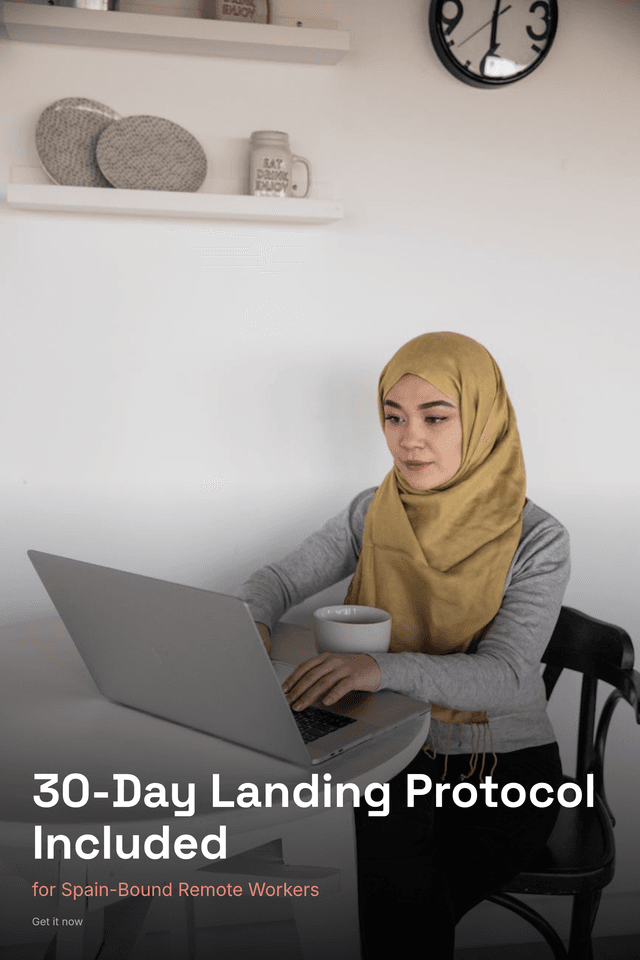

This entire product — 13 chapters, 15,000+ words, cover image, sales copy, and Pinterest pins — was created by AI in minutes.
Not days. Not weeks. Minutes.
Try Kupkaike Free — 20 Credits →Your Turn to Bake.
Everything on this page was generated from a single niche idea. No design skills. No copywriting. No code. Just your idea, and Kupkaike does the rest.
Start free — no credit card required
The definitive step-by-step relocation blueprint that takes remote workers from
AI-generated digital product